

Are we forgetting how to think?
Notes on an increasingly deteriorating society due to AI, IP and all the other ones

I.
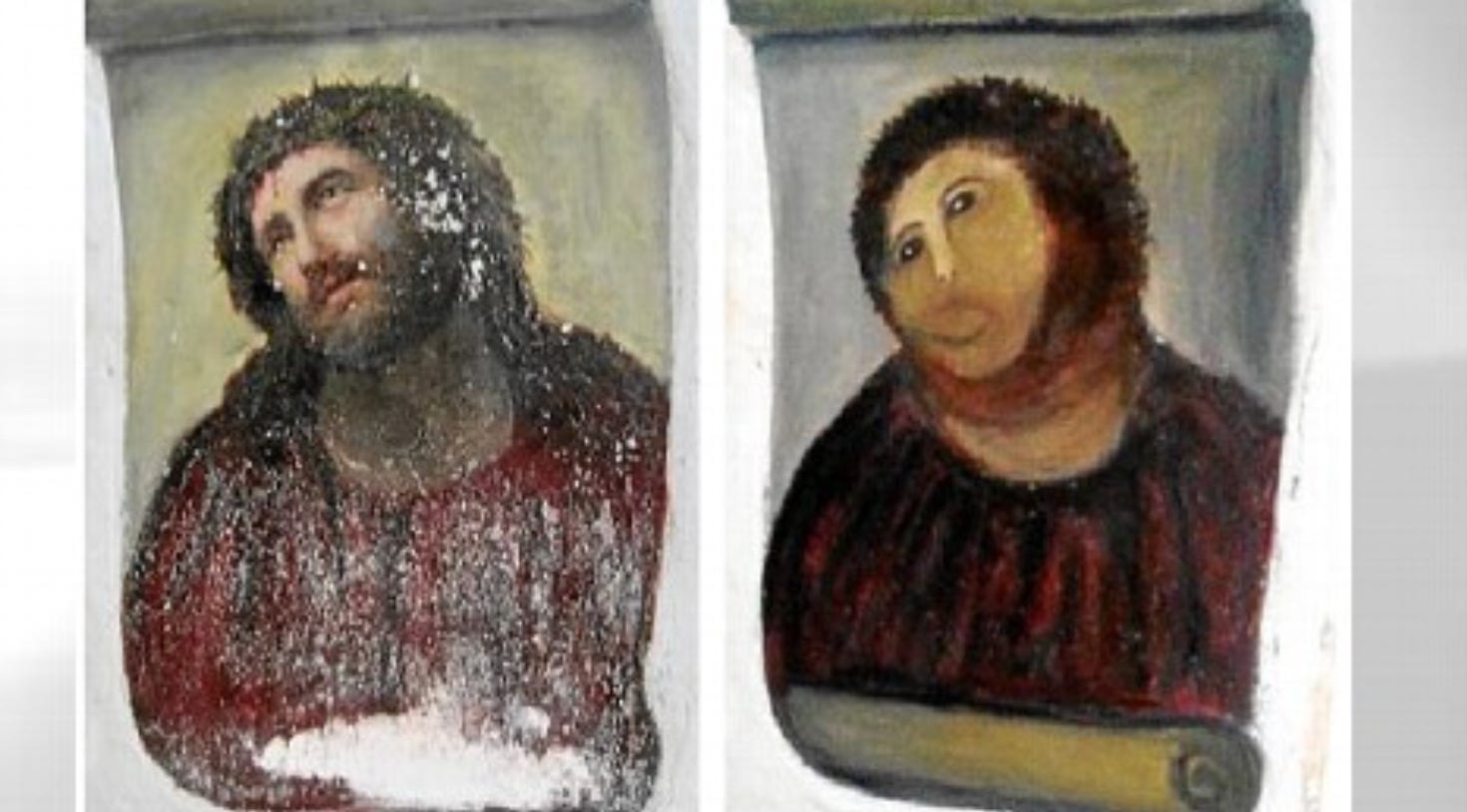
Do you remember the elderly woman who "restored" a painting of Jesus’s face and it ended up looking like a hairy, possessed blob instead? That’s what AI generative art looks like to me. The “artwork” it creates is so unnatural and ugly, like a really shitty collage or a child’s half-assed mosaic.
II.
“She tells you what to think.”
In the fictional sci-fi short story “The Perfect Match” by Ken Liu (from his collection The Paper Menagerie), an AI program/personal assistant named Tilly has become an everyday tool that most people use. Employing surveillance and (of course) loads of personal data, Tilly does everything that Siri does… and then some. Tilly offers unprompted suggestions throughout the day about specific music choices that will put you in a certain kind of mood, exact menu items you should order (and pay for) for a little nighttime snack delivery, and even potential romantic partners with people who will be (based on each individual’s collected Tilly data) “a perfect match.” Tilly is in your ear all day long – on the date making suggestions of conversation topics to ensure the match is “successful,” telling you what to eat, telling you what music to listen to, telling you what to purchase and what to consume.
And there’s the rub: Tilly doesn’t just “make your life easier.” Tilly suggests. Tilly thinks for you, so you don’t have to. After a while of using a program like this day in and day out, coming to depend on it, the mental muscles you used to exercise for decision-making (even for simple, mundane choices) get weaker since you’re not flexing them. The part of your brain that used to be able to form opinions, preferences and personal tastes gets dusty over time the less you reach for it. As one anti-AI character in the story (who’s on a crusade to bring Tilly down) says:
“Tilly doesn’t just tell you what you want. She tells you what to think. Do you even know what you really want any more?”
Liu’s story was first published in December of 2012 – thirteen years ago. I wonder how many more years until we completely forget how to think or want for ourselves.
But something tells me it won’t be long.
III.
I believe there’s something seemingly very small on the internet that has given many people the courage (and ease) to openly lie about their credentials and that thing is: the social media profile bio.
On any platform, you get to tell people in a few words who you are and what you do. You get to create labels for yourself, a brand, and no one is going to fact check you. I’ve seen people in Los Angeles who took two hours of a standup workshop add, “Standup Comedian” to their Instagram bio a few days later. Hell, maybe they even added it that night. Or while sitting in that very workshop. Anything fuckin’ goes. Hell yeah, rock ‘n roll.
Social media has made it easier than ever to just say you’re something even if you’re not really doing the thing that would make you the thing you say you are.
The internet is the perfect place for people who can talk the talk but not much else. And with the rise of AI, what better time than Now to steal other people’s work and claim it as your own? The more information, research and writing that gets fed into one big generative algorithm, the less accountability theives will have to feign.
“I didn’t even know it was stolen,” they’ll say – if they cop to it at all.

IV.
They should go ahead and change the “Hollywood” sign to read “Intellectual Property” instead. What are they waiting for?
Many film industry people (including high-profile actors like Vince Vaughn and Dakota Johnson) are talking about how increasingly risk-averse Hollywood execs are becoming. The reasoning is pretty simple: studio execs – who for the most part do not come into the job out of a pure love for cinema, but rather a familial connection to the job itself1 – are getting greedier and lazier by the day. They want a guarantee that something has a spending-ready audience before even thinking about greenlighting it.
The days of taking a chance on a budding unknown screenwriter or director are slipping away from us. As I’ve discussed before, because of this, much of the artistry in cinema is dying – only to be replaced with lifeless recycled IPs in the form of sequels and prequels and spin-offs and “new” Marvel blockbusters and video-games-turned-movies.
This is why AI and film as it stands today go hand-in-hand: both are generative, with no mind of its own.
Even better: the sooner AI teaches us to forget to think or want, the easier it will be for mass audiences to stomach egregiously expensive films of insultingly horrible quality.
V.
There are now TikTok creators – some big ones, with millions of followers – whose main bread and butter is doing parodies… of other TikTok videos.
The formula goes like this: an (ideally) unstaged TikTok video goes viral. Within hours of its takeoff, people run to the comments of that video and start tagging their favorite “parody” creators, begging them to parody this hours or days-old TikTok video. The popular creator then delivers and usually surpasses the original video in views and engagement.
So, to summarize: the good part of TikTok (a normal, average person capturing a random slice-of-life moment that makes people laugh or feel joy) now has to be copied immediately by another person who’s not so average (has millions of followers and is an influencer and brand embassador). I put “parody” in quotes here because, from what I can tell, these are hardly parodies and more just silly, sort of drab line-by-line, step-by-step reenactments… You can hardly call these comedy sketches. I mean, can you really even parody something that's only existed for a couple of hours?
The world that AI is helping to shape into one repetitive, mushy glob would say yes.
VI.
Who or what will write books in ten years’ time?
More importantly, who will read them?
VII.
As has been reported by many a pop culture website, there was no “song of the summer” this year. This is a true cultural tragedy, seeing as how the last two summers had not just their own songs, but their own themes (Barbie summer in 2023 and of course, Brat summer in 2024).
So whoever (or whatever) was supposed to tell us which song to like the most really dropped the ball this year.
Or worse, maybe we can still think for ourselves2 – but there was simply nothing that moved us.
I don’t really have a source for this other than Life, and also a studio exec I will not name who said as much at a speaking engagement I attended.
for now…
To maintain faith that the world will not devolve into slop we need to ironically spend more time outside. It’s increasingly concerning that there is a generation of people who will be reared for digital first experiences unless they rebel. SV technocrats already hate humanity and think it’s passe, they’re trying to recreate their version of utopia at the expense of ours.
I just read “The Perfect Match” two weeks ago in my Intro to Sci-fi class! Eerily prescient.