

Sorry, but you’re all being kind of weird about 'One Battle After Another'
Notes on a (film) bro-pocalypse

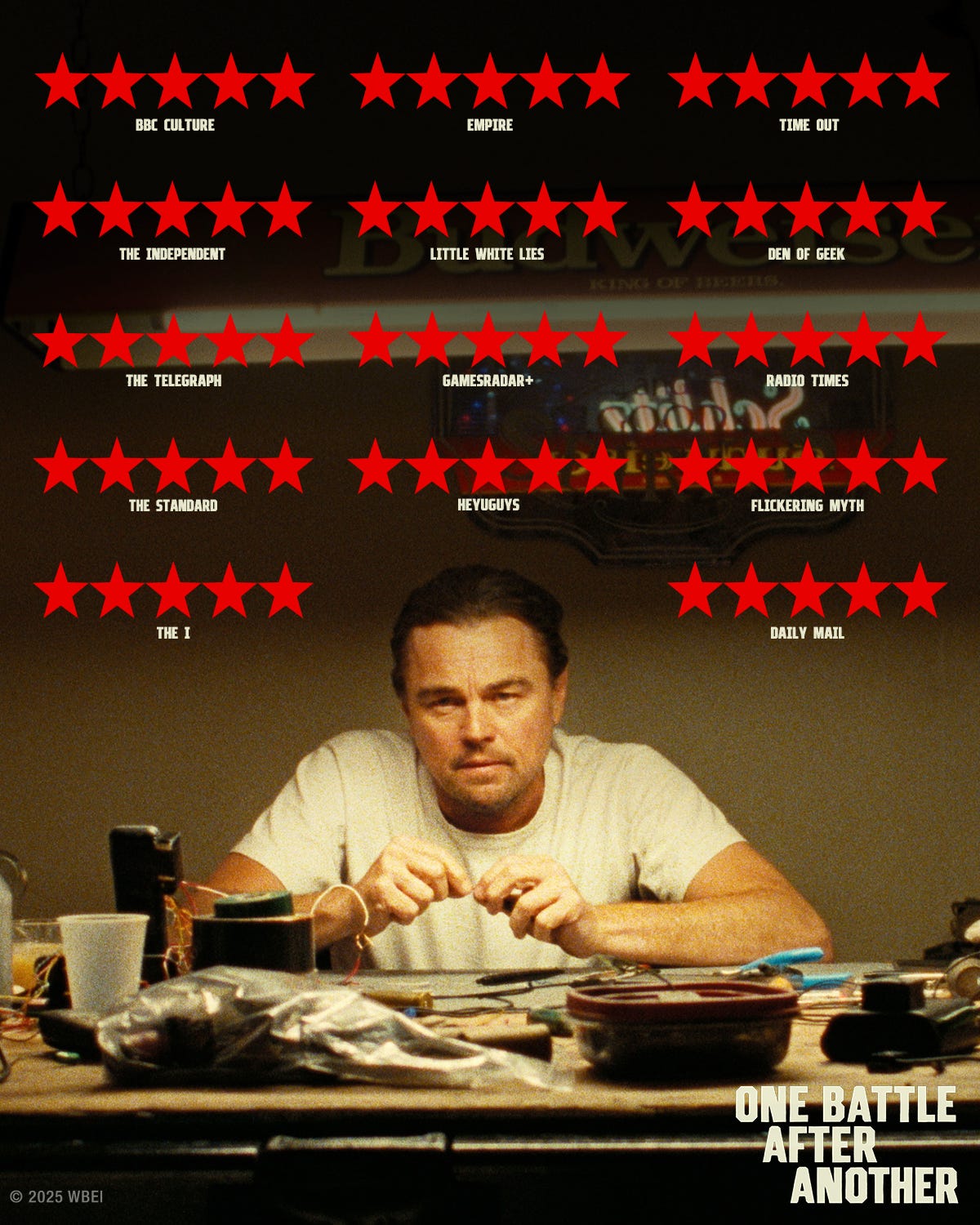
In recent memory, I cannot think of one film marketing campaign that has put such an emphatic emphasis on positive reviews from critics and high online ratings from everyday people quite like the promo for Paul Thomas Anderson’s latest feature, One Battle After Another.
The (arguably) overly-positive onslaught continues now (just as strongly, it seems, if not stronger) almost a week after the film’s release. Before even early Thursday screenings, critics were calling One Battle After Another “a modern masterpiece.” They were saying this was not only the “best movie of the year,” but the best movie of the decade.
When I saw the instant-classic-ification of this film start a week before its release, I started to get nervous. Here was a film I really, really wanted to like, and I did not appreciate the overhyping that was already beginning…
When I saw the “100% on Rotten Tomatoes!” push a few days before its release, I got a bit more nervous (though boasting and obsessing about Rotten Tomatoes scores is not new at this point). But when I saw the “already rated 4.5 stars on Letterboxd!” posts on social media a few days before the film’s release, that’s when I had a pretty good feeling that we were cooked.
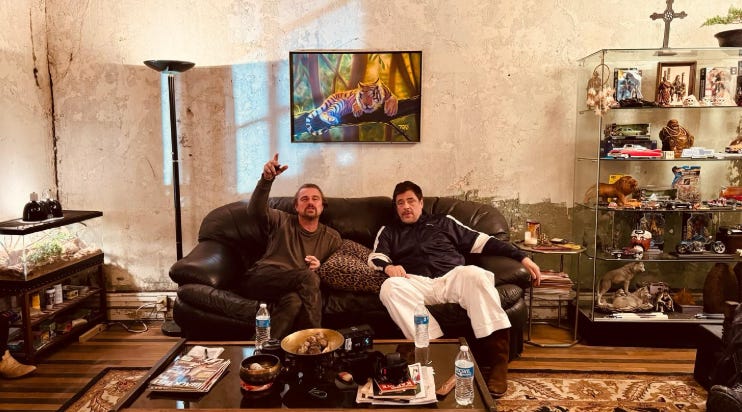
An ominous vibe was in the air, and just in time for fall. It was almost threatening, like a subliminal message played backwards when you rewind the Travis K*lce interview with Leo and Benicio… saying something like: thismovieisthebestfuckingmovieandyouwillfuckinglikeitgoddammit.
Well I, for one, did not like it… Many writers and critics have expressed my thoughts way better than I ever could: like Brooke Obie’s piece “One Fetish After Another: PTA Exploits Black Women and Averts Revolution, ” this rich and detailed piece by Tony Christini, and this brilliant review from Aisha Harris for NPR.
I don’t want this post to just be a review because, again, I cannot explain my feelings better than the pieces I just referenced, but I found the film pretty hollow: full of hacky Gen X humor and faux progressivism, with little point and even less character development (especially for the female characters, who are still somehow the driving force behind the story?) I cannot for the life of me understand how the “what time is it?” joke lasted for what felt like thirty minutes – precisely twenty-eight minutes longer than it needed to.
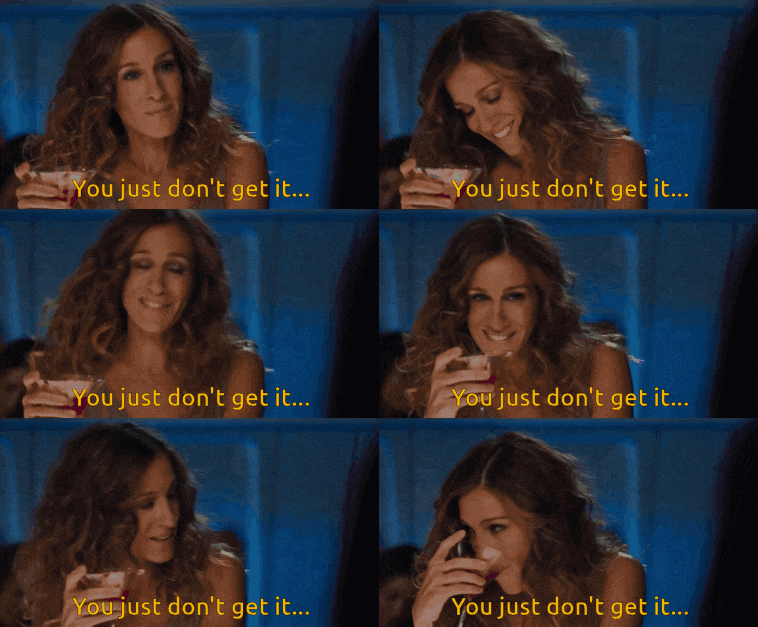
But that’s fine! We don’t all have to like the same movie. In fact, it’d be weird if we did! Right?…. Right???? ……
…..
…………..
(guys…???)
…….
…….. Right????!!??!
Currently, it feels like it’s almost “not allowed” to dislike this movie or even have critical thoughts about it. Like it’s some kind of cinematic treason if you dare speak against the Almighty Paul Thomas. “Film bro” is a term I’ve often thrown around with friends for fun, but never quite understood just how prevalent (and bullying and annoying) they are/can be until this very moment.
As I said, I am not the only person in the world who didn’t like the decade’s best movie. We whisper shared sentiments amongst ourselves in private, using hushed tones so PTA’s “Well, Actually!” Brigade daren’t find us.
Under some negative or critical reviews on Letterboxd, film bros flock to the comments to say it’s “rage bait” or use clever meme-like phrases such as, “Tell me you don’t understand movies without telling me you don’t understand movies.” Or even more obnoxious: “I went to your profile and saw your Top 4. Yeah, no surprise here!”
In Reddit forums I’ve scoured (100% my own fault, I know, but it was research), a few disappointed and confused film bros write long paragraphs about why they weren’t a fan of the movie even though they love PTA’s other movies (including Licorice Pizza1). Their fellow film bros write back in longer paragraphs about why that take is wrong, how they must just “not get the tone of the source material” (the book it’s based on…) or how they’re not sophisticated enough to understand what PTA was going for with this one and how personal this film is to him!!!
Between the painting of a very broad brush from critics and moviegoers and the torrential downpour of social media marketing declaring near-perfect “scores” on film lover websites, something… rings false to me, and I can’t quite put my finger on it. But I will say the general vibe, if I had to describe it in a few words, is simply: somethin’ ain’t right.
It’s clear that studios, producers and the stars themselves want to get ahead of the “Letterboxd Effect”: the power of the people to go to a website and click a few stars and write a one-liner review that could make or break their film’s box office success. By telling us “no, this film crushed with people just like you! Trust us, it’s a fan favorite!” before it even has fans, the film as a corporation can start to take back control in this vulnerable arena. Who’s to say that kind of rhetoric doesn’t start to influence our opinions, especially when it seems to be coming from the websites we cherish the most?
Studios and film marketers today know they need the approval of the “online cinephile,” but the spaces film buffs had to determine if a film was really “of the people” or not are dwindling before our very eyes – down to something that will soon be unrecognizable (just another marketing tool). No matter how niche a social media platform may seem in the beginning years, every platform can and will be manipulated and bought by the commercial and corporate powers that be. That is the ultimate purpose of these platforms, after all, no matter how you dress them up.
All Hollywood has to do (and already is and has been doing) is pivot slightly and adapt to our new avenues of finding and rating movies – the little dark corners we thought we were carving out for ourselves to enjoy and commentate on entertainment with likeminded people. In the end, perhaps, we were just telling them how and where to brainwash us.
One Battle After Another is definitely not the first film to be critically acclaimed and highly rated by most, with others left out and wondering “why.” But I do feel as though something is amiss when it comes to the masses jumping on this heavily endorsed, predefined “icon status” bandwagon – and bullying those who don’t join them.
Listen, people can like what they like. But why does the love for this film in particular feel so oppressive and aggressively fanatic? Why do I feel like Pacino screaming “Attica! Attica!” as I see the positive reviews continue to roll in with verbiage that sounds like studio-distributed copy? Why does this one feel just a bit like a PSYOP? Why do I feel crazy?
It’s weird, right? I just need you – or anyone, please! – to tell me it’s weird.
do not even get me started
This is the era we’re living in — not the one where a critic like Kael could savage a film and start an actual conversation, but one where an algorithm needs your consent to maintain its illusion of consensus. The cult around a movie like this feels oppressive because it’s designed to. The “fan reaction” you’re seeing is no longer entirely fan reaction; it’s a new aesthetic of marketing where corporate hype and authentic enthusiasm are blended so seamlessly that it’s impossible to tell which is which. It’s not that people are wrong for loving the film; it’s that the system now punishes dissent. Even the platforms we once thought were “ours” — Letterboxd, Reddit threads, the dusty little back rooms of online cinephilia — are, as you said, just new storefronts for the old machine.
You’re not crazy. It is weird. And it’s not just about PTA. It’s about a culture that can’t tell the difference anymore between a masterpiece and a psyop, between a sincere opinion and a corporate script. And maybe that’s why so many people are clutching the movie so tightly: because the only way to prove you’re not lost is to shout that you “get it.”
People want to like One Battle After Another for a wide variety of compelling reasons, and it has a lot of positive qualities. The problem is that the film is obviously and fundamentally vulnerable to accurate critiques of blatant racism and sexism, not only in prominent scenes but structurally too: the upfront blatant "blaxploitation" with its hypersexualization, and then the relative marginalization of all the minority characters who seem to be continuously placed to propel the plot for the near continuous presence of the white male main character and his one-note story. Deeply biased, at best, this tale, seemingly as old as time.
And such a critique just scratches the surface of the issues. Going into much more detail on these and related problems is Brooke Obie’s piece, as you note, “One Fetish After Another: PTA Exploits Black Women and Averts Revolution.” There's a lot of evident truth in her observations and conclusions:
"Because the plot is a showdown between two white men fighting to hold onto Black and biracial women for reasons that keep them in constant conflict with each other. There’s no choice then but for the film to feel incongruent and exploitative of those thinly written Black women characters."
"Because Anderson is not interested in revolution. He’s not interested in vulnerable immigrants. Despite the many jokes about lusting for them, he’s not interested in Black women. He’s only interested in the interiority of white men."
That most reviewers don't or can't readily see this is not much credible at this late stage of cultural history. Vacuous garbage and cesspool liberalism, so-called - these are significant elements of this film, woefully misjudged by the writer/director PTA and anyone else responsible for the production. The skewering of hideous reactionaries and condemnation of oppression and valorization of social justice workers and so on helps offset these flaws but doesn't eliminate them.
That most reviewers overlook this or excuse it and then hype what often amounts to a lot of Hollywood cliches as wonderful features of the film is symptomatic of a lot of other cultural problems besides, some of which you note in your post. The most vital and crucial characters, politics, and elements of culture are frequently exploited, distorted, and marginalized throughout the film badly undercutting the film's genuine qualities and strengths.